Published by:
CGP EDU Academic Team
Published on: September 12, 2026
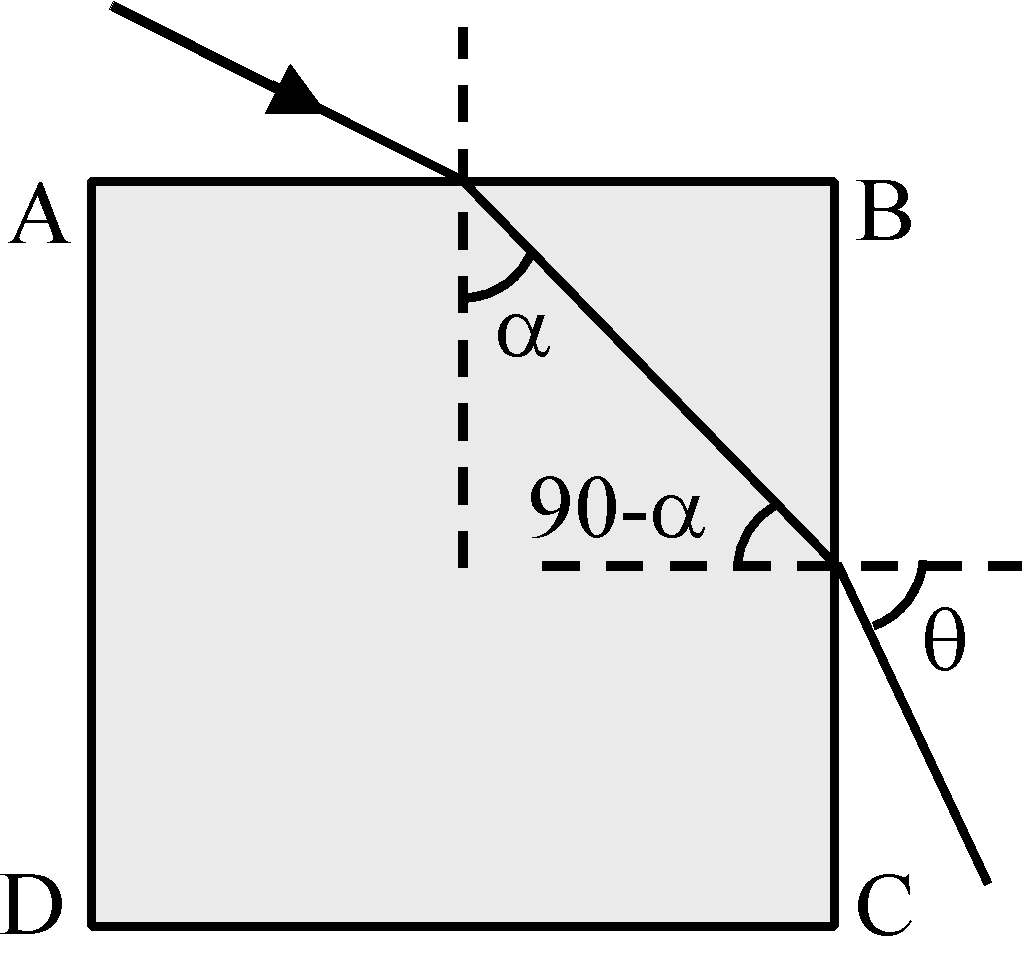
ABCD is the plane of glass cube. A horizontal beam of light enters the face AB at the grazing incidence. Show that the angle θ which any ray emerging from BC would make with normal to BC is given by ⇒ sin θ = cot α
where α is the critical angle. What is the greatest value that the refraction index of glass may have if any of the light is to emerge from BC?
Text Solution
Verified by ExpertsThe correct answer is:
A
Step 1: Understand the Critical Angle.
The critical angle (B1) is the angle of incidence above which total internal reflection occurs. It is defined as:
$$ n = \frac{1}{\sin(\alpha)} $$, where n is the refractive index of the medium (in this case, glass).
Step 2: Analyze the Incident Ray.
A horizontal beam of light enters face AB at grazing incidence, meaning the angle of incidence (i) is 90 degrees. At this point, using Snell's law:
$$ n_{air} \cdot \sin(90^\circ) = n_{glass} \cdot \sin(\alpha) $$
This implies that since n_{air} is 1, we have:
$$ 1 = n_{glass} \cdot \sin(\alpha) \Rightarrow n_{glass} = \frac{1}{\sin(\alpha)} $$
Step 3: Angle of Refraction.
According to Snell's law, at the interface between the glass and the air, when light emerges from face BC, let θ be the angle which the ray makes with the normal to BC. Applying Snell's Law again, we have:
$$ n_{glass} \cdot \sin(\theta) = n_{air} \cdot \sin(90-\alpha) $$
Since n_{air} = 1, this simplifies to:
$$ n_{glass} \cdot \sin(\theta) = \cos(\alpha) $$
Substituting the value of n_{glass} from Step 2, we get:
$$ \frac{1}{\sin(\alpha)} \cdot \sin(\theta) = \cos(\alpha) $$
Rearranging gives:
$$ \sin(\theta) = \sin(\alpha) \cdot \cos(\alpha) $$
Step 4: Using Trigonometric Identity.
We know that:
$$ \sin(\alpha) \cdot \cos(\alpha) = \frac{\sin(2\alpha)}{2} $$
So using cotangent related identities:
$$ \sin(\theta) = \cot(\alpha) $$
Thus proving that sin θ = cot α.
Step 5: Greatest Refractive Index.
For light to emerge from face BC, we must have:
$$ n_{glass} \cdot \sin(\alpha) \leq 1 $$
Hence, substituting the inequality we derived:
$$ n_{glass} \leq \frac{1}{\sin(\alpha)} \Rightarrow \text{Greatest value of } n_{glass} = 1 $$ when B1 approaches 90 degrees, or when total internal reflection is about to occur.
The critical angle (B1) is the angle of incidence above which total internal reflection occurs. It is defined as:
$$ n = \frac{1}{\sin(\alpha)} $$, where n is the refractive index of the medium (in this case, glass).
Step 2: Analyze the Incident Ray.
A horizontal beam of light enters face AB at grazing incidence, meaning the angle of incidence (i) is 90 degrees. At this point, using Snell's law:
$$ n_{air} \cdot \sin(90^\circ) = n_{glass} \cdot \sin(\alpha) $$
This implies that since n_{air} is 1, we have:
$$ 1 = n_{glass} \cdot \sin(\alpha) \Rightarrow n_{glass} = \frac{1}{\sin(\alpha)} $$
Step 3: Angle of Refraction.
According to Snell's law, at the interface between the glass and the air, when light emerges from face BC, let θ be the angle which the ray makes with the normal to BC. Applying Snell's Law again, we have:
$$ n_{glass} \cdot \sin(\theta) = n_{air} \cdot \sin(90-\alpha) $$
Since n_{air} = 1, this simplifies to:
$$ n_{glass} \cdot \sin(\theta) = \cos(\alpha) $$
Substituting the value of n_{glass} from Step 2, we get:
$$ \frac{1}{\sin(\alpha)} \cdot \sin(\theta) = \cos(\alpha) $$
Rearranging gives:
$$ \sin(\theta) = \sin(\alpha) \cdot \cos(\alpha) $$
Step 4: Using Trigonometric Identity.
We know that:
$$ \sin(\alpha) \cdot \cos(\alpha) = \frac{\sin(2\alpha)}{2} $$
So using cotangent related identities:
$$ \sin(\theta) = \cot(\alpha) $$
Thus proving that sin θ = cot α.
Step 5: Greatest Refractive Index.
For light to emerge from face BC, we must have:
$$ n_{glass} \cdot \sin(\alpha) \leq 1 $$
Hence, substituting the inequality we derived:
$$ n_{glass} \leq \frac{1}{\sin(\alpha)} \Rightarrow \text{Greatest value of } n_{glass} = 1 $$ when B1 approaches 90 degrees, or when total internal reflection is about to occur.
Prepare Smarter with CGP Edu
Get practice questions, solutions, and test series in one place.
Write a Review
Share your experience with this question and solution.
Commentary
Send your comment, doubt, correction, or feedback to admin.
Similar Questions
Explore conceptually related problems
A student can distinctly see the object upto a distance 15 cm . He wants to see the black board at …
Two plane mirrors. A and B are aligned parallel to each other, as shown in the figure. A light ray …
A concave mirror of focal length is used to obtain the image of the sun which subtends an angle of…
A square of side is placed at a distance of from a concave mirror of focal length The centre of …
A thin rod of length lies along the axis of a concave mirror of focal length One end of its magni…
A ray of light falls on the surface of a spherical glass paper weight making an angle with the nor…